
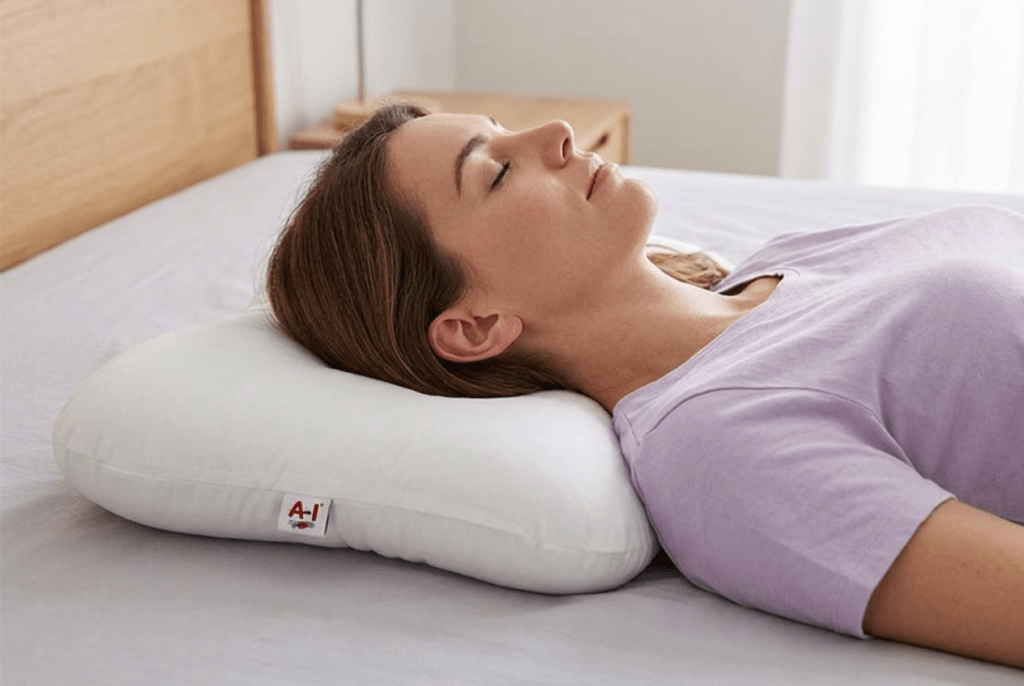
The best pillow for neck and shoulder pain is something that most of us are searching for in today’s modern world. It’s so hard to avoid neck and shoulder pain completely in a world full of technology. Even if we try our best to stay away from using our phones, most of us spend at least 8 hours a day in front of a computer just to make a living.
So, since we can’t avoid it completely, we’re going to have to find a solution to our problem, and that solution is a pillow that’s designed to help relieve neck and shoulder pain. In this article, we’ll go deeper into what it takes for a pillow to be considered the best pillow for neck and shoulder pain so that you can end your neck pain nightmare from now on and going forward.
Your Pillow is the Secret to Pain Relief
Before we dive into the “how-to,” let’s talk about the “why.” Your neck and shoulders are a complex highway of nerves, muscles, and vertebrae. When you sleep, our goal for you is “neutral alignment.” This is simply a way of saying your ears, shoulders, and hips should form a relatively straight line. If your pillow is too high, your neck tilts up. If it’s too flat, your neck collapses down.
Both scenarios put your muscles under “stretch” or “compression” all night long. Imagine holding your arm out at a weird angle for eight hours—it would be exhausted the next morning. That is exactly what is happening to your neck without a proper pillow for neck and shoulder pain.
The Side Sleeper: Filling the “Gap”
If you are a side sleeper, you are in the most popular group, but also the one most prone to shoulder pain. When you lie on your side, there is a massive structural gap between your ear and the tip of your shoulder that we must address.
The Problem: If your pillow is too soft or too thin, your head drops toward the mattress. This pinches the nerves on the underside of your neck and overstretches the muscles on the top side. Worse, your top shoulder usually collapses forward, leading to that “pinched” feeling in your rotator cuff.
What We Recommend:
- High Loft: You need a “thick” pillow for neck and shoulder pain. We suggest a height that matches the distance from your neck to your outer shoulder.
- Firmness: Look for structural integrity. We find that memory foam blocks or heavy-duty latex are superior because they won’t bottom out halfway through the night.
- Our Pro Tip: Grab a second, thinner pillow and hug it. This keeps your top shoulder from collapsing forward, taking the pressure off your chest and upper back.
The Back Sleeper: Supporting the “Curve”
Sleeping on your back is technically the best position for your spine, but we know it can be the hardest one to find a pillow for. Why? Because the back of your head is round, but your neck is a curve that needs to be “filled in” rather than pushed up.
The Problem: We often see back sleepers using pillows that are too puffy. This pushes the chin toward the chest, which is essentially the same posture we use when looking at our phones all day (“tech neck”). If you wake up with a headache at the base of your skull, your pillow is likely too high.
What We Recommend:
- Medium Loft: You want your head to sink in just enough that the pillow cradles the back of your skull while actively pushing up against the nape of your neck.
- Contour Pillows: You’ve likely seen those pillows that come with a “dip” in the middle and two “neck rolls.” We consider a contour pillow for neck and shoulder pain a back sleeper’s best friend.
- Material: Memory foam, latex, polyester, and water pillows are what we consider most effective for supporting your neck night after night.
The Stomach Sleeper: The “Minimalist” Approach
We need to have an honest conversation about stomach sleeping. From our perspective, this is the toughest position for neck pain. To breathe, you have to turn your head 90 degrees to one side. Imagine sitting at your desk with your head turned sharply to the right for eight hours.
The Problem: Most pillows are far too thick for this position. If you sleep on your stomach with a standard pillow, your neck is being arched backward and twisted at the same time. This is a recipe for chronic neck stiffness.
What We Recommend:
- Low Loft (The Flatter, The Better): You need the thinnest pillow possible. In fact, many of our experts find that stomach sleepers feel best with no pillow at all under their head.
- Softness: Look for compressible materials like down or down-alternative. We want something that stays as close to the mattress as possible.
- The Adjustment: Instead of putting the pillow under your head, try putting a thin pillow under your pelvis and hips. This prevents your lower back from arching and helps keep your entire spine in a more neutral position.
Materials Matter
Once we determine your loft (height), we need to choose your “stuffing.” The right material can transform a standard cushion into an effective pillow for neck and shoulder pain.
- Memory Foam: We recommend this for localized pain because it contours to you. If you get hot at night, look for gel-infused options so you don’t wake up sweaty.
- Latex: This feels like memory foam’s “bouncy” cousin. We suggest this if you move around a lot because it snaps back into shape instantly.
- Down/Feather: These feel luxurious and “cloud-like,” but we caution that they require constant fluffing. If you have severe neck pain, these usually don’t provide the consistent support we like to see.
- Water: This is one of the most popular options on the market recently. A water-based pillow for neck and shoulder pain is perfect for customizable support, allowing you to add or remove water to adjust the firmness level.
Give Your Body Time to Adjust
When you finally choose your new pillow for neck and shoulder pain, we want you to make us one promise: Don’t judge it on the first night. Your muscles have “memory.” They have been compensating for a bad pillow for months, maybe years.
When you switch to a pillow for neck and shoulder pain that actually supports you correctly, your muscles might feel a little different—maybe even slightly sore—for the first few days as they learn to relax. We ask you to give it a full 14 nights before you decide if it’s “the one.”
At the end of the day, you don’t have to live with a morning “stiff neck” as your status quo. We believe you deserve to wake up feeling like you can actually move. Let’s get you back to waking up on the right side of the bed.


Leave a comment